

The fastest, least disruptive path to new AI revenue is not waiting for the grid, but reclaiming the stranded power already inside today’s data centers.
Sadia Raveendran, GTM
Transform stranded power into AI-ready capacity & revenue.
The AI surge has accelerated scrutiny of the digital infrastructure sector and the pace of its deployment. The race for available power is redefining strategy for hyperscalers, colocation providers, and enterprises. Amid this industry pivot, a critical lever is often overlooked. Instead of waiting years for new grid allocations, the fastest, least disruptive path to revenue is reclaiming and orchestrating “stranded” watts i.e., untapped and underutilized power already available within today’s data center footprints. Hammerhead AI’s platform unlocks up to 30% additional AI-ready capacity from a facility’s existing power allocation, translating flexibility into near-term revenue, not just interconnection queue positioning. This approach lets operators scale, adapt, and thrive in the now, while being ready when flexible grid power becomes available.
Power as the Industry Bottleneck
The exponential growth of AI compute isn’t just filling racks, it’s reshaping entire power grids. U.S. grid planners anticipate a need for up to 100 GW of new peak capacity by the end of the decade (Source: Utility Dive) and every tier-one market is feeling acute constraints. OpenAI wants 1 GW of AI Infrastructure per week (Source: Business Insider), when the U.S. added only 63 GW of capacity in all of 2024 (Source: EIA). This stratospheric surge in demand is driving grid operators, utilities, and data center executives alike to ask: how do we keep up, both operationally and financially, as grid upgrades struggle to match the pace of AI growth?
Flexibility: Current Solutions Target ‘Speed to (Grid) Power’
Consensus has quickly formed that “flexibility” — the ability to adjust loads and operations in alignment with utility needs — is central to unlocking new capacity. Most attention, however, is focused on using this flexibility as a bargaining chip to accelerate grid connections. For example, data centers are promising to curtail grid draw for less than 100 hours per year (Source: PowerMag) in return for larger or earlier capacity from utilities. Models like this now dominate capacity negotiations in crowded markets, such as Virginia and Dallas.
But this paradigm is encumbered by the dependency on external grid planning. The grid becomes both the path and the bottleneck for scaling, often pushing new revenue opportunities uncomfortably far into the future.
The Missed Angle: Use Flexibility Internally to Unlock Stranded Power
What’s missing from the current conversation is how much capacity (and therefore revenue) can be unlocked within the data center, without changing grid allocations at all. Typical data centers are sitting on a gold mine of underutilized power. For most data centers, only 30-50% of contracted grid power gets utilized (Source: LBNL), due to the persistent gap between peak and average utilization, contractual guardrails, and legacy belt-and-suspenders provisioning.
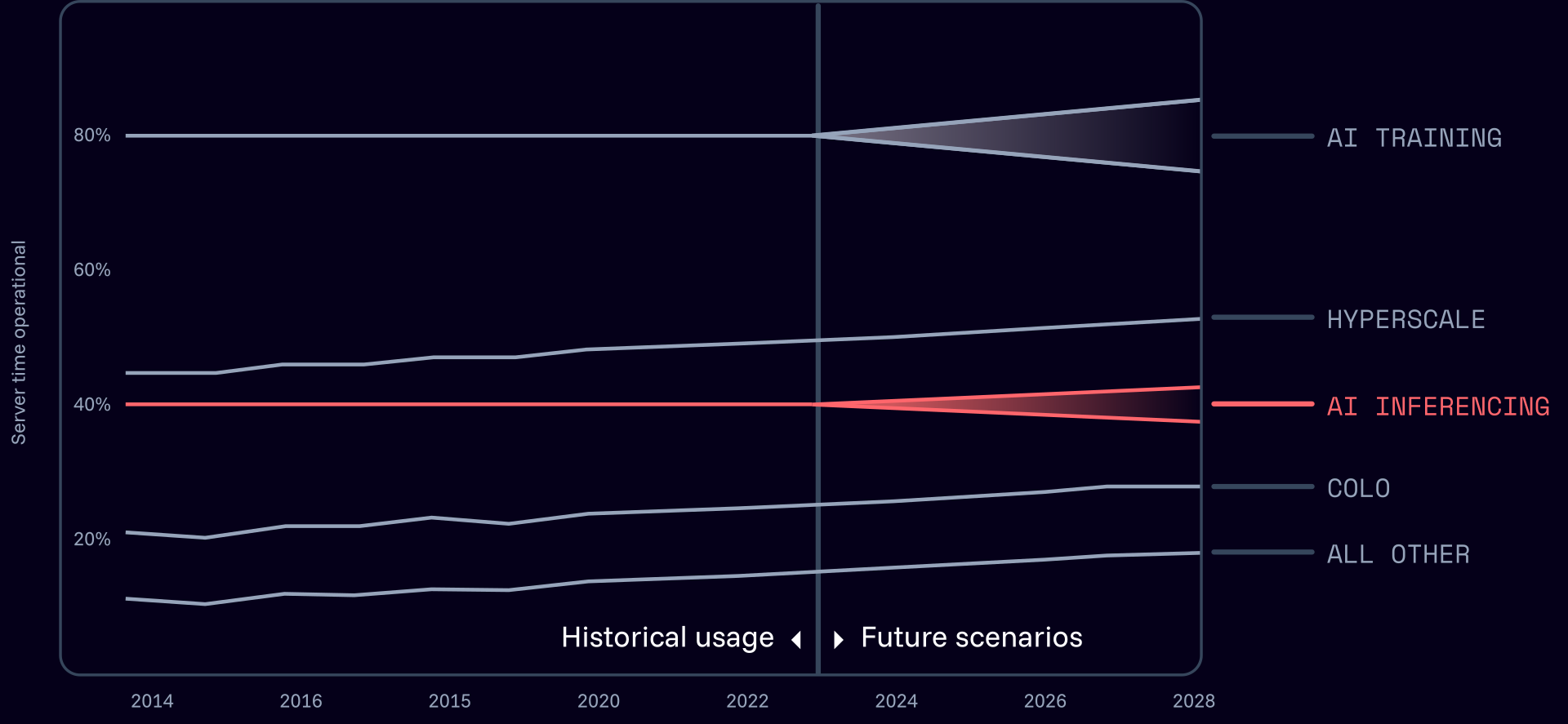
Source: Shehabi, A., et al. 2024 United States Data Center Energy Usage Report. Lawrence Berkeley National Laboratory, Berkeley, California. LBNL-2001637
These are generally known as “stranded watts,” and the headroom is substantial. Both Google (Source: Research) and Microsoft (Source: Microsoft Research) have documented 25–30% increases above nameplate design capacity through compute orchestration alone. By dynamically orchestrating power, cooling, and compute to unlock and operationalize every available watt for token production, we believe that flexibility can be directly leveraged to unlock more revenue for data center operators, without dependence on the grid.
This is the essential innovation Hammerhead brings to AI and digital infrastructure: immediate, autonomous revenue unlock from stranded power, not hope for a future utility handshake.
Hammerhead’s Approach and Its Strengths
Concrete financial and business impact: For operators in congested markets, every additional 1 MW of usable power can translate directly into $20-50 million in value, without fresh capital commitment to upgrade power infrastructure. By maximizing token output and operational margins from existing assets, this approach insulates against external economic or regulatory volatility, making revenue and growth fundamentally self-directed.
Sequencing: Synergy with Grid Flexibility Needs
The value proposition of Hammerhead’s platform additionally extends beyond just unlocking stranded power. ORCA can also support data center operators asking for faster, flexible allocations from the grid. For these flexible data centers, the platform seamlessly delivers token maximization using a variable power limit instead of a fixed one, making it future-proof. In other words, we provide a sequential, not exclusionary, journey: monetize stranded capacity first for near-term wins, then layer on grid flexibility to achieve speed-to-power.
In this context, token output can still be protected if the same amount of grid flexibility can be sourced from outside the data center. In general, demand-side solutions have scaled significantly over the years to deliver reliable dispatch-grade capacity. In fact, it was the Hammerhead team (working at AutoGrid) that built and scaled the industry-leading grid flexibility management platform, Flex. This platform, integrated with their customer engagement solutions, enabled Uplight to triple its flexible capacity to 8.5 gigawatts (GW) across 59 utility programs; this aggregated capacity was delivered within 3% accuracy (Source: GlobeNewswire). Such battle-tested and scaled solutions offer an attractive alternative for operators, as compared to reducing token output (and therefore revenue) to achieve speed-to-(grid) power.
Conclusion
Grid-centric solutions will remain essential, but business leaders cannot have their growth be solely reliant on processes external to them. The deepest, fastest, and most strategic wins come from unlocking the value of power that has already been paid for and provisioned. Hammerhead’s orchestrated, RL-powered solution demonstrates that data center operators don’t have to choose between flexibility and financial control. They can have both today.
